



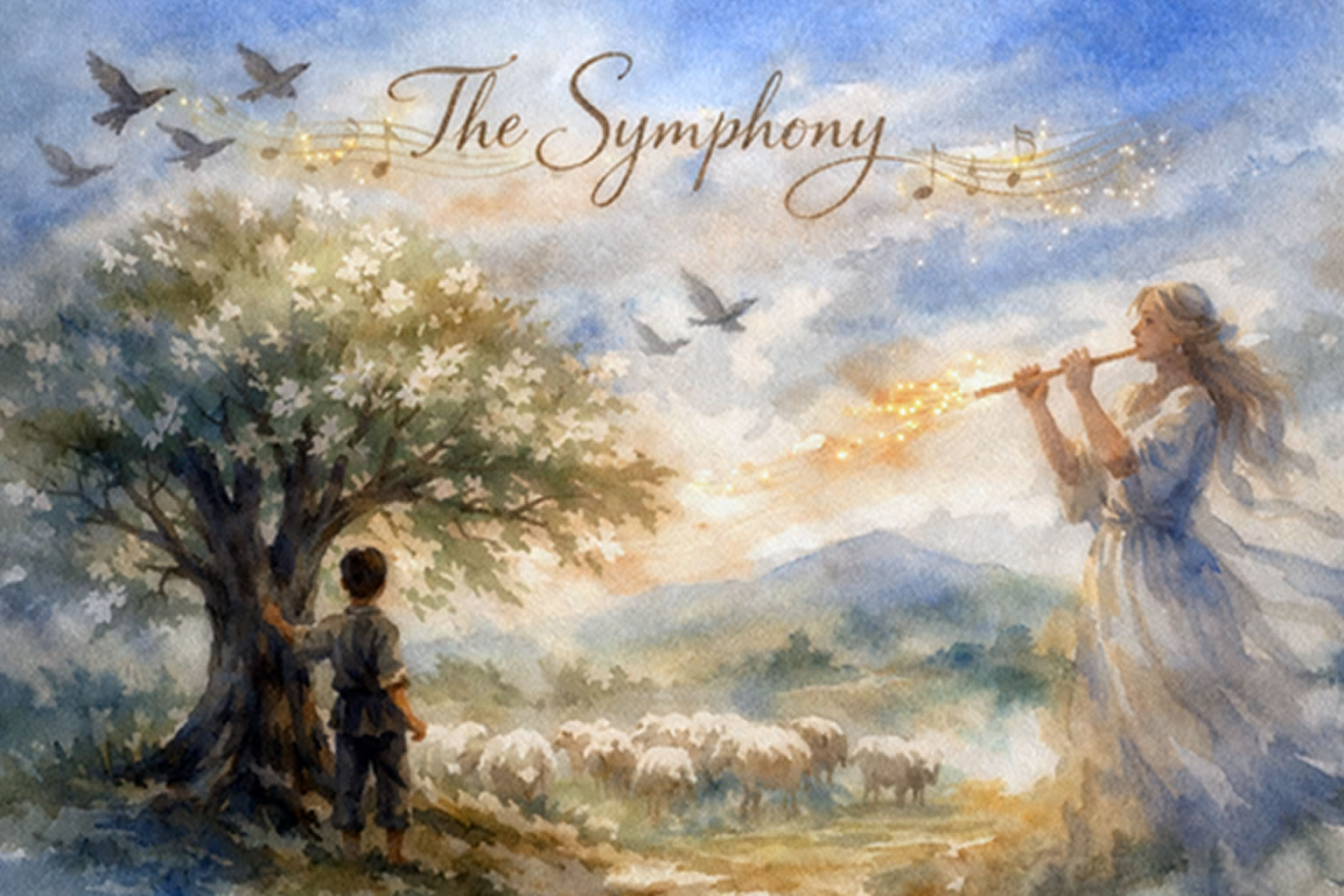
“I wrote The Symphony as one who rediscovers his childhood beneath a linden tree. It is the story of a boy who finds refuge in nature, strength in beauty, and salvation in love from the cruelty of humankind. Through this work, I affirm that innocence can resist, that love can rise as an army, and that writing may save what power could never redeem.”
Beneath the shade of a young linden tree, much like himself, lay the gatherer of sage and firewood, weary from the day. Beside him, the small pile of sage stood witness to his long labor. There, among the hills, was his true peace; a heartbeat without noise, without whistles or shouts, without braying or howling, without the stick of the schoolmaster, and without the merciless clamor of life. There was only the breeze, carrying to him the scent of linden. There was only stillness.
The boy of sage and firewood wanted nothing from anyone. He was tired of life and all its meanings that spun in his small head. His father beat his mother for putting too much salt in the food.
— and the time before, for putting too little. His schoolmate stole sweets from the blind vendor. His young sister feared the birds because she could not tell which were male and which were female, so she closed all the windows in fright.
His name was Noor. And his dreams were as vast as the universe.
He would sell his firewood to a poor man who heated the women’s bath, taking a single coin for a loaf of bread and an olive.
— nothing more. Then he would return to the hills to gather thirsty thorns, hoping one might hide a jewel dropped by a bird from the sea.
— a gift. Perhaps it was the Rukh bird his late grandmother had told him about, the one that carried jewels from the land of serpents. Perhaps… And perhaps, in his solitude, he could hear the voice of God.
— the God who loves the pure, the loyal, the white-hearted.
But the linden blossoms withered and flew away in the autumn wind. Harvest seasons ended, and the clouds closed the gates of heaven. Noor struggled beneath the bare linden tree.
The linden spoke to him sadly:
— What are you writing for your last words, boy? The wind will strike you without mercy, and the rain will make floods that will sweep away the sage.
— and you with it into the depths of dark valleys.
He answered:
— But your root is strong, O linden, and in your veins there is still nourishment. May I hold you close, and may we live together, waiting for your next seasons.
— the seasons of your giving, which you scatter in the people’s breeze so they may breathe without poison?
She said to him with all the tenderness of the world:
— Hold me until spring… only until spring. For the people who kill love and deform beauty will come at the dawn of spring to make me firewood for their burrows, or sticks with which they betray one another. But you may rest assured… until the coming spring.
And so the boy and the linden became one body, fighting storms and floods, and in their love was salvation.
At last, the rays of the sun buried winter, watching the greening of life in the soil, then the rising of small moons from the buds of branches. Birds called to one another and perched upon the linden’s limbs.
But Noor did not hear the chirping. He heard the sound of a flute from afar
— the shepherd’s flute, the flute of love and spirit that turns the universe into joy. To its melody, the boy’s dreams fell asleep.
That year, his dreams were no longer of sage and firewood, but of love.
— the love of the linden, the fragrance of the linden, the flute of the linden, the shepherd of the linden.
The boy became a man, and he had made a decision.
He met her.
— The beautiful shepherdess, the flute player.
— I know that shepherds are usually men, those who slaughter sheep to please people. How did you become a shepherdess, O Light of Life?
— I am like you. I refused to slaughter the ewes and became their shepherd. You do not know how much I have suffered from people; they buried happiness beneath the feet of hatred. So I decided to be a shepherdess, just as you decided to gather thorns. Do you know that thorns hold much medicine? Why do they burn them.
— To spoil the air instead of healing the festering wounds?
— Then you are like me, O Light of Life. Are you ready?
— Ready for what, Noor?
— To defeat the wicked who want to uproot the linden.
The beautiful shepherdess fell silent, and two tears slid from her eyes. Noor approached and gathered the tears in his palms.
— Will you let me baptize myself with these tears, my beloved, and swear by them?
— But how, Noor? We have nothing with which to defend ourselves. He wiped his face with her tears and said:
— Here I am, O Light of Life.
— your tears are now within my blood. By them I swear: no one shall come near the linden tree.
— But how, Noor? The wicked understand only the language of power ,
— and we do not possess it.
— We possess the greatest power, and we have not used it yet. You and I have a pen. We can write on everything. Come, let us write on the bark of the linden, on the stones, on the flowers. Come, let us write on air and water. The wicked fear their own ignorance, O Light of Life. You and I and the linden and the sheep shall become an army, and our weapon shall be the flute that. carries our messages to the world. Come, let us sing…
— Listen carefully! Don’t you notice that the bleating of the sheep has become one sound? They are joining us in the symphony of the flute, to the rhythm of the linden’s rustling leaves.
*****
Zouheir Shalabi